|
|
|
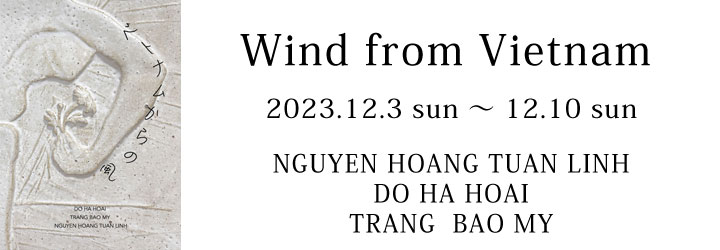
December 3 - December 10, 2023 |
NGUYEN HOANG TUAN LINH, DO HA HOAI, TRANG BAO MY |
|
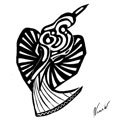
April 14 - April 20, 2023 |
Natacha Wisniewski |
 |
|
 |
|
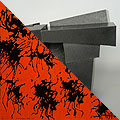
November 1 - November 13, 2021 |
Kiyoshi Hamada & Hikaru Yumura |
|
|
 |
|
November 14 - November 23, 2019 |
Kim Hankook |
|
|
 |
|
September 13 - September 22, 2019 |
Eiichi Tsujino |
|
|
 |
|
July 22 - July 31, 2017 |
Hiromi Ishikawa |
|
|
 |
|
|
May 1 - May 31, 2017 |
Kim Hankook |
|
After graduated from the Departments of painting College of Fine Art of Hongik University, he designed the sets of drama, stage and more as a designer of TONGYANG BROADCASTING COMPANY. The stage design of "POPS TOP 10" was also his work. Although stage design was challenging job, he began to think that drawing a paint as a painter is the vocation. Three to four years later, he started to draw in earnest. The professor of his graduated university charged him to be an assistant and a lecturer at the university while he drawing. He became a professor of Gangeung National University (Gangeung-Wonju National University) at the youth as 33 years old.
Since he have to spend a lot of time for education, it was hard to spend a time for creativity, but Kim Hankook worked aggressively and had many personal exhibitions at Yoon Gallery, Soo Gallery, Hwasarang, Gallery Dong Soong Art Center, Gallery 2000 and more.
When the South Korean economy got worse in 1997 to 1998, he decided to be a exchange professor in Paris with his family. Living in Paris has become the big opportunity for him to acquire a new perspective. After coming and going the boundary between abstract expression and photographic expression, finally he could break his own wall of expression with the fusion of photo, computer and printing, that was the biggest change for him. At that time, he visited many countries in Europe and Southeast Asia, photographed the nature and the state of people and engraved them in his mind. Through these trips he began to own the macroscopic and implicit perspective as a painter. That's why the "PROJECTION - TRACE" series and the "FLOW FORMATION FLUID" series were born. Also these inspiration made the driving force for aggressive activities at the art fairs in Hong-Kong, Chicago, New York, Geneva and more after 2008. Especially, the exhibition of "Worm's Eye View Series" in Scope Basel was introduced in the English magazine "Identity" same as famous artists of whole world.
Destiny begins with a very small coincidence.
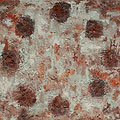
After Kim Hankook completed the exchange professor and return to South Korea, SARS was prevalent in worldwide. The thermographic cameras were working without a break in the most of public agencies. The airport was not an exception. Kim Hankook says he could not take his eyes off from the monitor which indicated the figure of the people in red shape. The figure of the red human being indicated through the lens was coming closer as a fresh form. From this time, he began to have his own perspective.The quest for the delicate human world, the essence of present situation, through his third eye has begun.
After using thermal images as a medium for painterly awakening, he has begun to face the destined coincidence once again. He got new inspiration from a small column in the newspaper. It says "Human civilization has developed from ancient times based on a bird's-eye view (eyes of bird look down the world) ". Therefore, precise parts are missing same as the different of the forest seen from a distance and the forest seen in the forest. However, we need more precise thought, worm's eye view (eyes of insects watch the world) in present."
"See the world from the worm's eye view"
Kim Hankook noticed that this is the new perspective that he have been thinking for a long time. Since then, he creates the "Worm's Eye View Series" in the motif of the thermographic camera and eyes of insects. Expressing the diversity and the deep entity of the world precisely with essentially and subjectivity not objectively through eyes of insects which have a so many eye lens as a painter. It would be unique word of him who is trying to purify the world.
Kim Hankook thinks that everyone can have his own third eye.
His work embodies the different facts which were dismissed from the common sense and missed from the modern civilization with the possibility of painting. |
 |
|
|
December 16 - December 27, 2016 |
Yoko Nakamura |
|
|
 |
|
August 1 - September 3, 2016 |
Hidetoshi Takahama |
|
|
 |
|
|
May 30 - June 13, 2015 |
Hidetoshi Takahama |
|
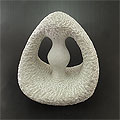
Even now, most of the people will remind the human body reflexively when heard "sculpture". Because the appearance of invisible god was expressed as a human body from ancient time. Also as Nietzsche said "God is dead", the human became a interest subject for sculptors replacing the world of myth and religion, after modern era. Since then, incalculable number sculptures of human were created. However, a sculpture of human was forced to surrender gradually the seat of the protagonist without some exceptions in late 20th century. Since modern civilized society which was build by human instead of the god or the attorney of god, is filled with contradictions and absurdity, it never be the utopia.
In that sense, sculptor Hidetoshi Takahama is the exemplary man who is struggling sincerely to modeling a natural phenomena and an invisible sign replacing a human body which is the current important issue of sculpture. His extraordinary modeling force has been highly praised in each exhibition. Which give a existence to robust pebble and the sculpture would be incarnated into the organic nature after highly elaborate work as carving and planing, polishing.
Please do not miss this opportunity and enjoy his literary masterpieces. |
 |
|
|
November 7 - 15, 2014 |
Yukari Arisaka |
|
Loftiness aestheticism artist Yukari Arisaka is painting the "world" which can be translated to pictures by the painter. It has also called "Composition of Existence" by Maurice Merleau-Ponty.
I always think that a strong belief to paintings might be harbored in the heart of a quiet Arisaka. Arisaka wrote "Catching the infinite image from the information, which might be thrown away before it is perceived by unconscious and felt by subconscious, is the mission which can be achieved only by abstract art." in her doctoral thesis for the graduate school of Tama Art University.
The Surrealist caught a image of subconscious which is just a part of unconscious. On the other hand, to perceive a image of unconscious from the world that spreads inexhaustible and uncertain and to realize it as picture with indefinite line and point, layers of colors. That might be a place where Arisaka aims.
Since eliminate the psychological influence which color brings, her works in 2000's were painted in monochrome. Also a form and a matiere were inhibited. When the viewer looks into her works, the viewer tried to be connected to the inner world of oneself and find a meaning by overlapping sense and memory at same time.
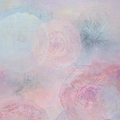
After 2010, Arisaka began to express a sensuous and colorful screen which reminds a fertile and sublime image with colors like red, orange or purple. Arisaka is intending to express the "Unconscious Image" by abstraction. Sometimes also it seems to express a figure of small animal like a pigeon or a rabbit. It reminds me of a primitive form like the scene of the Greek mythology where Gaia, Tartarus and Eros are born from Chaos or the scene of the Old Testament "Genesis" where God creates the light in the darkness, separates the waters and the earth and creates the animals.
In her new works "Petrifaction" and "Flowers of Mist" for this exhibition, there are figurative motives of a swan, a human or a flower. The figure not only limits the meaning, but also it expands the communication between a picture and a viewer. This is the new development of Arisaka. Even if these images were the expression of a figure or a mental crosses Arisaka's mind, that reminds the construction of a magnificent world and surely suggests the hidden possibility of Arisaka. |
 |
|
|
November 8 - 16, 2013 |
Yoko Nakamura |
|
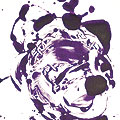
If you look close to the screen, you will be overwhelmed by the crowds of vestige which was made with speedy action. Otherwise, if you look over the whole of vestiges, all the dynamism is made to be forgotten and you will be wrapped in secretly. Yoko Nakamura's works are known as the duet of the occasional change of nature and the silence which freezes on the change. This impression, that is likely to cut all the changing sound, reminds us of the "General Pause" of the Romatic music which uses even the silence as nourishment. The "General Pause" of the symphony which uses all sounds as nourishment and the silence on the paintings, which is the final goal of repeated expression are not essentially identified in the same category. However, Nakamura's work which was sublimated by the organic combination of the dynamic details and the luxurious silence "General Pause" which impresses next creation seem to be overlapped within me.
The dynamic motion and speed which are the pronouns of Nakamura's paintings are produced with not a paintbrush but her palm, or her fingers, which is called "Finger Painting". The "Finger Painting" that removes the restriction of a paintbrush was brought by the trend of modern-paintings which aims at the direct expression related to the gesture or the act. Simultaneously, if we see the fact that ancient human beings had left the cave wall painting by the same drawing technique, relation of the "Finger Painting" and the desire to return to the origin will not be able to be disregarded, either. Although I have forgotten to ask her why she uses fingers and a palm instead of a brush, it must be correct that her choise to use them was based on that she was aware of something which can not be satisfied by a paintbrush. Nevertheless, these exhibited works show that only the primitive dynamism which was directly linked with a gesture or an act is not the final goal which the artist has searched for. Because, we will see not only paintings which were drawn with fingers and a palm but the two types of paintings which were derived from the "Finger Painting". One of them are the works which were rubbed, extended and transmitted by Valen from the "Finger Painting". Another one is covered the "Finger Painting" with gypsum, dug it partially and made to appear the screen of lower layer. The focus of the former is on the form which is appeared in the front instead of the eliminated substance. On the other hand, the latter focuses on the color which is exposed partially from the lower layer of white gypsum. The paintings of Nakamura which was started from expression with fingers or a palm are moving forward to research of a form and color which are the fundamental element to form painting. Yoko Nakamura pours the breath of a thrilling expression into every screen, then she expects patiently to establish the image which she desires. |
 |
|
|
October 17 - 26, 2013 |
Madoka Shibata |
|
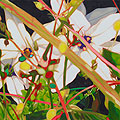
In these 6 or 7 years, flower is the most important motif for Madoka Shibata's oil paintings. Although she is particular about flower, her motif is not nature morte but flower which is alive in nature by her side. Moreover, her paintings are different from the flower which was observed by the botanical viewpoint and depicted to details as French artist Pierre-Joseph Redoute or Japanese artist Hisui Sugiura. Also, there are the flower depicted like Botticelli's mythological allegory or Rousseau's paradise fantasy. Her very abstract painting is different thing either. Since bird which often appears in her painting, her painting can be called contemporary "Kachoga", the bird-and-flower genre in Chinese and Japanese painting.
Madoka Shibata creates her works by the consciousness of wishing to fill the whole of "field-of-view" with brilliant colors, rather than the motive to depicting the details deeper. For example, her concept is firmly consistent from "Pattern of Pink Flowers"(2006) to "Yellow of Distances"(2009), "Flowers in Line"(2010) and "Bloom, Blossom"(2012). Especially in latest three paintings, the shape of the flowers became masse and connect each other to expand their colors, like a daydream. The form of flowers looks like a magnetic field which attracts brilliant colors before appearing the graceful.
On the other hand, she also challenges to break out of her shell and make a new departure. For example, the paintings which expressing a infinite depth with vertical angle like "View of Flower"(2009), "Relation of Flowers"(2012) and "Seems to Go Upwards"(2013). Or the paintings expressing a flower which changed into a sunlight filtering through trees like "Light of Distances"(2012). However, there is already a pioneer of similar expression of these trials by Rieko Hidaka, O'Keefe, and Naofumi Maruyama. Therefore, I would not like her to stand still, but I wish her to continue pursuit and create to open up her own new field. |
 |
|
|
April 1 - 10, 2013 |
Shiro Uchiyama |
|
|
 |
|
March 1 - 9, 2013 |
Fujiyama Satsuki and Seki Takayuki |
|
|
 |
|
|
January 18 - 26, 2013 |
Reiko Hara |
|
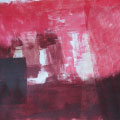
Oh! Wind is flowing here. Light shines from far away and sound can be heard.
Can be felt the natural breath which made us such image from Reiko Hara's work. Hara says "My works were born by the inspiration from the material called textile." There is something which makes us an image of "another nature". Even if it is abstract, that image can be said the dignity which was derived from concreteness or inspired by some emotion.
Hara's work can be seen like painting or soft sculpture. Although she has chosen the material called fiber, her mode of expression is not limited in one. The work is exactly the "shape" which appear by passing Hara's creation filter. Unrestricted her work impresses the quiet and abundant reverberation of "another nature".
A life seen in nature. Spring - Young innocence. Summer - Aggressive youth. Autumn - Manhood of harvest, Winter - Simple and refined old man.
Hara says "I would like to express the beauty of each season."
Nestle close to the nature, affectionate to the nature, abstract the shape from the nature.
The works of Hara who relishes flowers is consistently borne by the dialog with nature.
We will sense that we are an part of the nature by her works. |
 |
|
|
November 24 - December 1, 2012 |
Naoko Nojima |
|
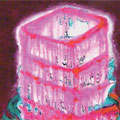
I was held captive to Naoko Nojima's vivid colors and inexplicable image when I saw her solo exhibition few years ago. I induced her to hold the solo exhibition at DOKA Contemporary Arts to solve the sorcery of her image. Although Nojima's work looks gaudy because red or pink were used, it was filled with dignified colors and obscure shape seems to resist a decipherment.
Nojima wrote "My work is like my own mental image as personal picture, not personal novel. Gathering the unconsciousness and realizing into obscure shape." "In my self, there is certainly something which cannot assimilate if I did not make into work." on her blog.
The title of her works is like a poem with smart and refined mystery as well. It is asking "Can you understand my feeling?", but at same time it looks like saying despairingly "You never understand my feeling." Even as the personal novel, Nojima's work is the spokesperson of atmosphere and nothingness of present day which can sympathize with contemporary people.
After 3.11, the influence appeared to her work either. By the shape and number, some one may interpret something from 4-set work "Outside of Outside of the Box is Inside" For Nojima, a building or a plant is just a thing which lay on her mind at that time. Your soul must be shaken by a natural hymn when you see her work as the testimony of her pure everyday life. |
 |
|
|
November 3 - 10, 2012 |
Satoshi Koyama |
|
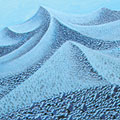
The exhibition "Outcry of City - Satoshi Koyama" had started on March 11, 2011 and the Tohoku earthquake occurred on that day. A foriegn person who was that exhibition said "City is same situation as this picture, now. Koyama's works stay ahead of the curve."
"Life City" series which is the lifework of Koyama was borne accidentally in late 1970s. Aerial photograph of Tokyo and a view from Kasumigaseki Building which was the tallest building in Japan at that time were the starting point. Since his work became the cover picture of "Coin Locker Babies" written by Ryu Murakami in 1980s, Satoshi Koyama's name and works came to be known well. His fame became firm after he was awarded the Yasudakasai Art Fundation Encouragement in 1978, prize of scholarship association of the Art Exhibition of Kanagawa and the 3rd Prize of the Exhibition of Shell Art in 1979 and the Grand Prize of the Koiso Ryohei Award in 2000.
Koyama who born and grew up in Amakusa, Kumamoto with great nature, came up to Tokyo in his early twenties. He was really shocked and said "My first impression of the huge city is unforgettable." The huge city which continues increasing perpendicularly horizontally and filling crevices. There is his own serious cry behind his works named "Life City" series. The screen was filled with buildings, cannot feel a human's life, though.
He stated "All the people are trying to seek and eat up all of the feeds in front of them. Politics, economy, education and so on... Are these really right?" when he was awarded the Grand Prize of the Koiso Ryohei Award. The image of increasing buildings is a self]assertion and desire of human. An influence never ends. Reaching to the summit of mountain and even covering the whole trees and island.
Koyama's exhibition which is held in the "War of Desire" of Japan, China, Korea and Russia entraps all the people to the labyrinth of deep gloomy thought. After you see his works and struggle in quest of a meaning, you would get the global view of the present world. Steep yourself in Koyama's world might be the better way to watch the times. |
 |
|
|
October 20 - 27, 2012 |
Hikaru Yumura |
|
Since Hikaru Yumura awarded Excellent Artist Prize at The 5th Yasudakasai Art Fundation Encouragement Award Exhibition in 1986, There are many opportunities to see comparatively as the museum collection or the public collection. Stoic and placid form without gorgeous color or decoration provides calm peacefulness for the people with natural harmony.
Yumura's work was made with granite which combined skillfully with a polished surface and a section. This contrast reminds us the rivalry of "knowledge and emotion" or "Yin and Yang". The uneven crack surface defuses an overbearing stone sculpture. It impresses humor, even when it is huge sculpture.
His works have consistency and own criterion as his words "I would like to confront and communicate with genuine stones to express their dignified space." When you see the work after reading the title, you will be made to realize the form was made after mature consideration.
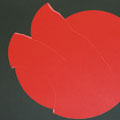
He exhibits his collage works for the first time. The form torn by hand was placed on layered colored papers by his exquisite color sense which can not see in stone sculpture. As he said "Breaking a stone and tearing paper are based on a homogeneous concept.", you will also sympathize with the collage work. Although Matisse used only scissors to make cutout in his later years, Yumura uses a cutter to express a section like julienne. This can be said to have succeeded in enjoying the essence, which was cultivated in long career of sculpture, easily.
The work is good to hang on a wall. When you see it, a comfortable breeze blows, the wind spreads to the blue sky. You will feel yourself who connected with nature. |
 |
|
|
September 14 - 22, 2012 |
Aika Furukawa |
|
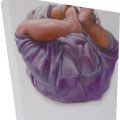
Aiko Furukawa's work fascinates and leaves continuously aftertaste. Her motifs are ordinary things like garments or clothes, but they are swallowed up to sky in a concentric circle. Ordinary clothes, which people put everyday, turned into unrealistic world and creates a fresh stimulation by her recombination work.
Furukawa says "When I feel some feelings which argues in daily life or an unconscious habit consciously, it rouses my interest." Moreover, people's life is an act with being repeated, which does not overlap though. Her unique style, which expresses that by swirl, is brilliant individuality.
She is going to study in Leipzig, where she had residency before, as up-and-coming artist overseas training member of the Agency for Cultural Affairs. Her brand new works are the decision declaration and they guarantee the future leap. |
 |
|
Collaboration of Picture "Satoshi Koyama" & Sculpture "Hidetoshi Takahama"
A Shape of Life and Water
at Hamaya in Nagasaki |
May 30 - June 4, 2012 |
Satoshi Koyama & Hidetoshi Takahama |
Collaboration of Sculpture "Hidetoshi Takahama" & Picture "Satoshi Koyama"
A Shape of Water and Life
at Kenmin Department Store in Kumamoto |
May 15 - 21, 2012 |
Hidetoshi Takahama & Satoshi Koyama |
|
|
November 18 - 26, 2011 |
Sumiko Hamada |
|
In temperateness monsoon region of East Asia, "Washi" was material which has cultivated the sensitivity of people who live in a climate of the crescent-shaped archipelago. Therefore, "Washi" was continuing influence on the origin and the position of art culture of the crescent-shaped archipelago in many ways. However, Sumiko Hamada is positively using "Washi" in present art world from the other consciousness than the consciousness to respect the gene of Japanese unique culture. As she recalled that "Canvas holds the paints on surface, but "Washi" does not hold the pigment like desert which absorbs water. That permeability gave the transparency and the depth to the screen and led me to the another beauty which canvas can not lead.".
When I heard that, I recalled the another artist who reached "Washi" in the same consciousness. Hiroya Hori, the seniority generation who is continuing making the work in which many layers of torn "Washi" which colored by a Chinese ink, a watercolor painting or a acrylic are stuck on a canvas or a panel. He was also one person who found out the way out on "Washi" with which pigment permeates deeply after he felt sense of incongruity for canvas which can merely perform heaping up paints. Although both style is different completely, consciousness and directivity which try to assimilate their feeling and a quality of space to matiere are common. Anyway, it is important that Hamada encountered "Washi" while she was trying to open her self to all possibilities without being caught by the traditional aesthetic sense.
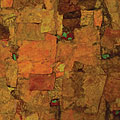
The pieces of "Washi" which torn and heaped up by Hamada's hands were dyed by various colors as green or blue after put a tone by Chinese ink.
Beauty of the changing color tone which contains delicately light and shade. Dynamism of the undulations and the movement which engraved by the pieces of "Washi". Those varieties of the expression and the depth of engraving will earnestly charm the people. The suggestiveness which can be called "another nature" or "another world" are in everywhere in the screen without any object. We should be able to appreciate the colored poetry with the leaves of indication of deep autumn by her new works. |
 |
|
|
November 1 - 6, 2011 |
Toru Kuranuki |
|
|
March 11 - 19, 2011 |
Satoshi Koyama |
|
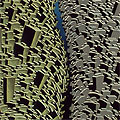
"City" is the place to support people equally in the present age. However, it was often interpreted negatively as a leviathan who alienated human and nature. Satoshi Koyama who started creation in 70's is the one of the artists who spent his adolescence not in such huge city. Buildings which reduced to windowless cube continue endlessly.
Such strange spectacle of "City Series" shows it eloquently. His works were invited to exhibitions such as "Shell Art Award", "Memorial of Shigeru Aoki", "Tenri Biennale" and "Memorial of Ryohei Koiso" and evaluated higher one after another. His nihilistic look which even surpasses surrealist Yves Tanguy might have scooped out people's minds sharply and nailed down their eyes. That is the one of the scenes of contemporary art with deep emotion.
However, I came to think that his works of "City Series" lead the city images of current people slowly but surely. I could do nothing but be surprised that inorganic and anti-natural Koyama's world turned to the global inner city or megacity before one knows. The strange buildings became trees or human bodies and turned to the bright life hymn. I can comprehend that because of nothing but his insight of the city. |
 |
|
|
October 22 - 30, 2010 |
Takehiko Kikuchi + Hikaru Yumura |
|
In the middle of severely heated August, I have received the e-mail from owner of DOKA Contemporary Arts, Chuichi Mogami. That e-mail said "I want to hold the exhibition titled "in Depth of Crack" with Takehiko Kikuchi and Hikaru Yumura." To tell the truth, it did not come tightly at that time. However, I consented to the title when I saw the pictures of both artist's work which I received later. Because the title leads me not only to external feature of works, but to the inner essence of aesthetics of both artists.
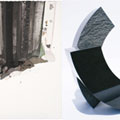
Kikuchi's works were expressed by watercolor, natural mineral pigments, Indian ink or rust, which were poured and drew with brush on washi (Japanese paper). Formerly, his works were composed with wide perpendicular lines accumulated closely which seems like <Stratum of Time>. In recent years, the lines got narrow like drippings and the style of painting has changed to emphasize the blank. The tip of dropping lines rounded like a root stock or spread like a puddle. Therefore, it gives the impression that an organic, natural feeling amplified. For Kikuchi, the line is not only to separate the space, it is the embodiment who inflames the passion of life. At the same time, what should make a special mention is that the lines which dripped by gravity are led by his aesthetics "Mutually exclusive dichotomy of making and coming". Which should be called "Aesthetics that receives intercession of nature".
Also, "Mutually exclusive dichotomy" is the exactly vital element for Yumura's sculpture which made of black granite. His trademark, the combination of the grinding surface like a smooth mirror and the crack with rugged surface, is that. If the grinding surface symbolizes the voluntary forming, the rugged crack should symbolize the forming of intercession which includes irrationality and chaos. It might be the aesthetics "Mutually exclusive dichotomy of making and breaking". His works are filled with a huge tension but also there is a humour that solves the tension through the skillful combination of conflicted elements. That is the unique characteristic of his sculpture.
In this exhibition, we might be able to appreciate the condensed new state of unique aesthetics of Kikuchi and Yumura. I would like to pay attention to Kikuchi's work, which stands upright with layered washi like a folding screen or a book that is opened and put up. There are short perpendicular lines which were accumulated only on the upside of the white screen. Though, the blank starts to move a esoteric time-space by the invisible colors, which appears from behind. And also Yumura's sculpture, which made of granite seems like separated by unknowable power, invites dazzle. I cannot help having expectations for this new exhibition "in Depth of Crack", which is composed of a layered washi and a space of shifted black granite which were piled up. |
 |
|
|
October 16 - 23, 2009 |
Tadaaki Okada + Hikaru Yumura |
|
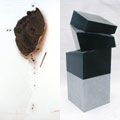
A lot of guides have been pointing out, "There are two confronted types in arts as organic and geometrical or as concreteness and abstract". These two contrasted types have been repeating the discord through the ages when either of them are more remarkable than the other side. For instance, Renaissance period that organic and concreteness ruled the age, and the 20th century that geometrical and abstraction ruled, oppositely. The base of painter Tadaaki Okada and sculpture Hikaru Yumura is the latter type either, that might be not irrelevant to the middle of 20th century, when they receiving the life. But yet we should note that they never swallow the type of the age, and not leave all of works to it.
The work of both has proven realistically. Moreover, their works seem even to contain the attention of skepticism to geometrical and abstract type which cover the age. It seems like they turn toward "One in the middle area" or "Dual one" between the two types, if I borrow the words from French novelist Andre' Pieyre de Mandiargues. Okada's screen is often divided in the rectangle, which divided into geometrical area in a word. However, it is different from the search for the principle wholly-devoted to start all over making the structure appear by heat because of the light of the intellect. In the first place, paint in screen is not homogeneousness, and there are plural stains of infinite form and segments with different directions. Because his works summon a organic motion into screen, which missed in geometric and abstract type. A similar impression will be able to be received from the sculpture of Yumura made from granite.
It can be said that it will dodge purity which the type impose though it is geometrical and abstract based certainly. As Okada whisks off the gravity which follows around geometrical and abstract type with free interventions of stains and segments, Yumura calls an organic dynamism into works with two composition methods mainly. For one thing, it settled plural parts which cut and shifted subtlety. As another, it confronts a surface which polished like mirror and a cut surface which is baring a rugged and bumpy section. The form contains a witty, humorous and a little thrilling sign, and it exudes the feel of vitality. There is nothing except saying that the strangeness of the skill that knows the material of stone thoroughly is special. Probably, Okada and Yumura are both keep searching the integration of confronted two types without belonging to either of two types of the art, like putting the body on the beach. |
 |
|
|
June 10 - 16, 2009 |
Koji Nishimi |
|
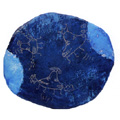
The plastic artist Koji Nishimi, who sets up atelier in Paris, and has permanent resident status.
He received the major impact to the cave wall painting such as Lascaux's, and he is expressing by the vision of the space of him that people return to the soil sooner or later, by his original colors. And keeps drawing the starting point of the life that will continue from the earliest times to the future. He exhibits to an international exhibition around France and Europe, and receives the prize repeatedly.
Born in Hiroshima in 1957, and went over to France in 1981. |
 |
|
|
November 21 - 29, 2008 |
Takamichi Ito + Hiroko Ohno |
|
Why should people pay attention when still life begins to move? Even the person who saw the still life should realize that concentrate his attention on it when it begins to move. It might be the influence of time which can not see. The person recognizes the flowing time when he seeing the still life. Therefore, his eyes can move to inside of his self from the real world. And creates an other time format of flowing of consideration. When the object which begins to move cut off the flowing of consideration (which was created to the inside), the time would get back to the real world.
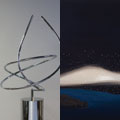
In that sense, Takamichi Ito who keeps sticking to the kinetic sculpture might be a dreamer who is possessed to shape the invisible time. Kinetic art is so popular in these days. It regales the people by variety of mechanism like reaction of natural phenomena or automatic movement with motor. But most of those things are caught in the movement of the thing, cannot shape the invisible time. Without Takamichi Ito who transforms the time of eternity into the tracks of a graceful dance by the rotary motion of delicate and humorous curve shape of polished metal.
As for the time of eternity, it is the motif of expression that the Japanese-style painter Hiroko Ohno keep sticking to. However, the time of eternity for her is not a ruined time which was installed on an old style like Sansui(landscape) or Kachofugetsu(4 elements of nature). Not only the base of activity moved to New York but also she has the preeminent action power and footwork and flies to anywhere if it touches her concern. It might be led by consideration which is human cannot commune with the time of eternity without the real experience of "Right now, right here". As she has been valuing the experience of seeing the rising moon at sunset in African desert.
Because she has the consideration, her work has not been ruined though it painted with Japanese paints or folded on byobu(Japanese folding screen). The hanging scroll was arisen from the experience in the desert is a good example, that places the desert as a boundary between the moon and the sun which were contrasted on top and bottom. It is not mysterious that the experience leads her to motif of the space of eternity. She often sprinkled an innumerable white dot on the darkness screen to draw the Milky Way or the constellation. With that minimal expression, she cleared completely and sings the desire for the time of eternity. |
 |
|
|
October 17 - 25, 2008 |
Tadaaki Okada + Hidetoshi Takahama |
|
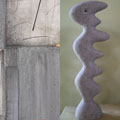
In my selfish guess, Tadaaki Okada could see the direction for which own work had to head since time when he had come to name his work "Onokoro". It is like the resolution to create his own world after fixed the preconceived ideas of painting. "Onokoro" is the first island of Japan which was created by Izanagi and Izanami with the salt which was dropped from their swords that sticks seawater. (by "Kojiki-The Records of Ancient Matters" The oldest history book of Japan, which was published in 712 AD.) We might feel the competitiveness against the Western painting, but we should sympathize with his self-knowledge that try to return to the starting point of painting. His consciousness could be seen in all of his works of "onokoro" series which recalls the Creation with the solemn screen made with calcium of powder of marble, carbonic acid, sulfuric acid and colored glue. His initial works with the colored natural tree and the principles of Yin and Yang by white and navy are especially invited to such a deep emotion. Okada's tracks progress to two contrasted affiliates announced while shaking off an extra element from the screen in a year or two of here. The comparison of white and black which delimited with red line makes the tension in silence. On the other hand, the thin line quickens the space and fills the atomosphere of growth. In this time, what is going to happen?
The movement of carvers who have the will to have their own exhibition of independent management has been rapidly highlighted lately. The fad painting of a "kawaii (cute)", a little unearthly and a surreal character. Since they reaches the serious sculpture, which makes a clear distinction between the fad figure, is not duly evaluated. Naturally, the age has the fad, but the all of the world is tainted with the fad is so fearful. To prevent it from the happening, carvers should hold out and let people know the real pleasure of the sculpture which the figure does not have. Also to Hidetoshi Takahama who holds the second exhibition of this year in DOKA.
Of course, Takahama will teach us the characteristic of the sculpture in this exhibition. It is the truth which can be conceived only from repetitive work as split, carve, scoop out, sharpen and polish the clod of the stone. I have already referred that his motif is the fluidity of the water at last exhibition. But also his works recall us a human body, an animal or a plant. The peculiarity of changeable and organic morphology is the key word of his work. In that sense, Takahama might be the one of the successors of Henry Moore who was sticking to not a classical balance beauty but a fluidity shape. |
 |
|
|
September 19 - 27, 2008 |
Jun Ogata |
|
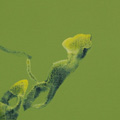
Even in the 21st Century, the traditional technique to draw the real things more beautifully is not lost. If anything, the chance to seeing such a painting is more abundant in daily life. Because the sense of security that might not disturb person's mind is requireed to the decoration in usual life. However, there is no reason to defend the old standard in the expression of art. Because German literature Hans Henny Jahnn says "Even the beautiful thing, the substance is a black of nothingness, a hole pierced by gravitation or an invisible existence for eye and spirit that have seen the contradiction of civilization and the irrational tragedy of war". Therefore, it is not a mirror of the true world though the picture still keeps planarity as of old.
These kind of paintings which are not caught by real world, can be said that they have own spiritual world. Such a painting is exactly what artist Jun Ogata has drawn consistently. A space filled with on color, like black like gross darkness, yellow like tranquil light, green like a dense nature. And a image like a mark of water drop, a shaking flame, a microorganism floating in the water or a twisted human body. Only those two elements are composing a Ogata's screen. Needless to say, the space that does not move and quietly is "Ground" and the image that melts and flows is "Figure".
However, you will feel a some kind of indication filled with deep reverberation from his work which was composed of "Ground" and "Figure". This exhibition is titled "Waon no Kubishi" which are the words not usually used. In my opinion, "Wa" might mean harmony, "On" might mean care and "Kubishi" might mean seriousness and mystery. Therefore, it might be a meaning of the world of spiritual world which was led by his inquiry of the harmony of "Ground" and "Figure". Of course, since "Wa" might mean Japanese style and "On" might mean warmth, it show his characteristic. His work has a deep inspiration like the Oriental painting rather than the Western painting which has depth and composition. It reminds me of an aesthetic sense of the old tanka(syllable Japanese poem) by Noriko Naishinno "A sadness of the dream of deep night does not disappear even if awaking at quiet daybreak". |
 |
|
|
June 19 - 25, 2008 |
Nino Karumidze |
|
Georgian artist Mrs.Nino Karumidze and her husband Mr.Zaza Gogua are the Japanophile. They stayed in Japan for long time, but now they went back to their home country, the Republic of Georgia. And she having a solo exhibition in Japan every year.
First of all, better to know about the Republic of Georgia before introducing her works. Georgia, was independed from the Soviet Union, has their original culture but also has the combined elements. Their state religion is the Georgian Orthodox Church which has derived from the Greek Orthodox Church. Georgia is a christian country but having the influence of a lot of other cultures through long history. The meat bun named Hincari is an article left by the deceased of the Mongolian empire. And an almanac of this country is the Gregorian but also has the twelve zodiacal signs. On the other hand, there are many influence of Islam which ruled for a long time. Which can be seen at the construction of the National Opera House or the architectural style of hot springs. In the legend, Georgia is the birthplace of the princess media and the place where Noah's ark landed. The nature and the wine of south Caucasia located at the east of the Black Sea are so famous. Georgian use kartuli ena (Georgian) with Russian. This country located at the crossroads between Europe and Asia and lying along the historic Silk Road routes.
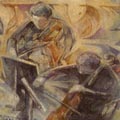
These Georgian cultures influence to her works. Her representational paintings with the decoration and the symbolism provide us to the world of various imaginations. Moreover, the soft changes of colors are the feature of her works. Most of her works are having a harmony of the drawn object and the background. Sometimes it plays a piece of music with harmony without a matter of what was drawn. The combined image must be the feature of Georgia where she was born and grown up.
Themes of her works are various but the music must be the pillar. "Pianist", "Quartet", "Piano Quintet" and "Concert" are representational but so symbolic works. Also, her works have elements of the humour and the trompe l'oeil (cheat picture). For instance, some children are hiding in the screen of her painting named "Hide & Seek".
In this exhibition, I am interested in which part of her character would be seen, or her new part would be seen. Please enjoy the meeting to her pictures and the conversation with her at this exhibition. |
 |
|
|
June 06 - 14, 2008 |
Hiroyuki Mogami + Hidetoshi Takahama |
|
A English poet and critic, Sir Herbert Edward Read(1893-1963) gave the definition to sculpture as his phrase "Sculpture is to replace the meaning from a material to another material". For instance, to build a sculpture is not to trace the shape of woman but to catch the meaning from the shape, when the woman is the material for the work. He is sure to have wanted to say that the sculpture was not a literal translation of shape but a free translation. In that meaning, Hisayuki Mogami is the only one artist should be called "The great translator of shape". His wooden sculpture was not traced the shape of material and not a pure abstraction sculpture either. His works associates us a human's gesture like a man is walking or laying. That has the deep relationship with life and existence, and the feeling might have been translated to many kinds of shapes.
No, it is not only that. His work title was named by the katakana that shows onomatopoeic phonomime. Art critic Yusuke.Nakahara was pointing out that his work title is "Sculpture word that the work speaks". He translates by not only the object but also the word. Therefore, he must be the great master of translator of the life and the existence. Mogami's unique objects and words might be laughing off the authority and power, and might be dislocating the common idea. So, they make us to feel refreshed. However, the world coming after laughter and provocation might be not nothingness but warm. By wooden sculptures, objets and drawings in this exhibition, we are sure to feel the unique morphology made with superb duet of objects and words.
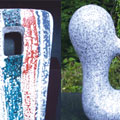
Stone sculpture artist Hidetoshi Takahama, who has been sticking to the motif of water, listens to the words that water speaks. Therefore, I want to call his sculpture "Shape of the water which translated by the stone" on Sir Read's word. What kept him to the subject of water? The answer might be in his own description, "The word of water is a inner voice of the earth". Of course, I will not disregard the environment theory of the earth, the planet of water. However, I want to read "Inner voice of earth" as "Outer voice of human", and receive it as the critical consideration of human supremacy principle in modern culture. Because his works with fragmented shape and combined making are on the other side of uniform human. His humorous shape sculptures with curve and smooth surface are having a fluidity like quick water. |
 |
|
|
May 09 - 17, 2008 |
Chiyu Uemae |
|
GUTAI art association, the legendary group of avant-garde artists was founded in Kansai after World War II by the guidance of Jiro.Yoshihara. It is a famous episode that Yoshihara who called Mr.Gutai encouraged the young artists to do something which other artist did not do.Also in foreign countries, GUTAI was well known from an early stage.
Chiyu.Uemae is one of the artists who joined the association since it was founded in 1954. Therefore, it was naturally that he should be take part in the favor of the glory. It might have been so in Kansai. However, in Tokyo and other area, the famous artists of GUTAI were Kazuo.Shiraga, Sadamasa.Motonaga, Saburo.Murakami, Shozo.Shimamoto, Akira.Kanayama or Atsuko.Tanaka. In that area, his existence tended to be overlooked.
It might if his work is unfavorably, but his art was not under at all. However, the current of the times chose Shiraga, Motonaga or Murakami than him. Because, they responded to the agitation of Yoshiwara with the unexpected action. On the other hand, Uemae was having a conversation with object and painting silently. In all kind of group, the person must play each role as a movement or quiet, a positive or a shadow or gay or sober, without his intention. People's judgments of an unexpected body expression and an honest search were clear.However, people in Tokyo should learn about Uemae's distinguished services in Japanese art history by this exhibition that exhibits the gem of his masterpiece.
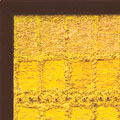
This exhibition exhibits his 1960's painting, 1980's series of stitch and so on. Therefore, people can learn about the transition of his style.The material surface that is the foundation of his work is as important as the variety of development.It is formed with thickly coated oil paints like a Gogh's work, or with the colored natural material like mouth of paint tube or sawdust and so on.He knew the Matiére conceives originality more than anyone. Originality arises from the Matiére which merged the material. |
 |
|
|
April 10 - 19, 2008 |
Kiyoshi Hamada X Masako Izaki |
|
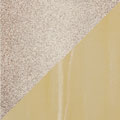
It might be called the disease of the age which soaked with a vast image. Even in the painting, a present concern became only the competition of concept and technology to work out a novel image. However, those kind of paintings just provide the ephemeral pleasures, and would be passed by devotee who has a endless desire of visual sensation. If the painting will become historical, it is necessary to search for the field where competition for image, concept or technology were transcended. To notice it for young painters and their supporters, there is nothing except to touch the works of the painters like Kiyoshi.Hamada and Masako.Izaki who are kept searching for the field.
I would like to approach to the fields like "Behind the Surface" or "Depth of the Surface" where they are searching for. Naturally, it is closely related to how their paintings consisted.
First, the work of Hamada assumes the group of the line and the stroke of similar color as the layer. And the entire screen is composed with the different colored layers like a geologic stratum. Then, the completed surface is dug up with a knife or a hook, and the colors of the lower layer and more lower layer were exposed. Therefore, these vast signs make the surface to covered with the dynamic unevenness, and the surface makes the scene of the unknown light has oozed out from behind.
In contrast, the tone of Izaki's work is faint and pale as the fog, and the paint is thin as the film that seems to be transparent. There are faint and soft tone flows like semitransparent veils soundlessly. And the piled up flows make stripes. That realise us the invisible depth of the surface. The work make our sight to round "Behind of Surface" and to read extensively "Depth of the Surface". Finally, turns reversely and sends us to the hither of screen. In that point, the elements of Izaki's works are similar to the Hamada's.
It recalls the wise saying of a painter "The painting is a container that catches everything".
The works of Hamada and izaki are telling the painting is the "Container" which opened toward infinity. |
 |
|
|
November 21 - 30, 2007 |
Yoko Kamijo |
|
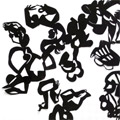
Artists are expressing their selves through the works.
Collectors are looking for the work with the sensibility and spirit which they like.
Therefore, the collections are describe the collector's character and sense.
DOKA Contemporary Art is presenting the exhibition to grasp the artist, from collector's aspect.
International artist, Yoko Kamijo expresses a wide theme around "Installation" in wide space. But it is hard to obtain her works.
This time, we collected her works of black for individual collectors.
At the same time, the race, religion and refugees problems of Palestine are taken up in politic, economic and social world, since 1948.
It is too large concept for a small gallery like us, but please enjoy this exhibition in silent and sensitive space. |
 |
|
|
September 21 - 29, 2007 |
Hidetoshi Takahama x Jun Ogata |
|
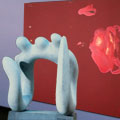
If we were born from water, our art should be rise from the spiritual world which has quality of the capital of water.
The collaborated exhibition of Hidetoshi.Takahama and Jun.Ogata attempts to realise us the quality of the world where we should return with the shape of the transformed of water. Also that would restore our memory of water and remind us that we were the water. |
 |
|
|
May 21 - 31, 2007 |
Noriko Ueda x Hidetoshi Takahama |
|
DOKA Contemporary Arts is handling the collaboration of artists.
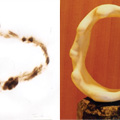
Two artists of this exhibition, Noriko Ueda and Hidetoshi Takahama, have always created a high-quality, Japanese abstraction work one after another.
The wind (Ueda) or the water (Takahama) is their own theme for a long time.
They are known as the artist who creates the delicate and high quality works. Therefore, they have been supported deep-rooted by some overseas art fans and collectors.
But also it is true that there is few chances to touch personally with their works except a part of art fans and collectors. It is different from other artists who catch the wave of the boom.
This time, DOKA Contemporary Arts planned the collaborating of these two artists who can express the Japanese sense of beauty refined extremely delicate and highly.
Their delicate and quiet works which a foreign artist does not have, are international because they are very Japanese.
Therefore, we collaborated these two artists, who can direct the calm and delicate place.
Please have their works closely and enjoy yourself as an opportunity to have the personal communication with artists. |
 |
|
|
December 4 - 16, 2006 |
Takehiko Kikuchi x Jun Ogata |
|
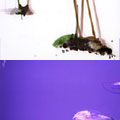
Takehiko Kikuchi and Jun Ogata have announced the high-quality painting of Japanese style modern art, one after another.
Both artist has been supported deeply by a part of overseas art fans and collectors.
But also it is true that there is few chances to touch personally with their works except a part of art fans and collectors. It is different from other artists who catch the wave of the boom.
This time, DOKA Contemporary Arts planned the competing of these two artists who can express the Japanese sense of beauty refined extremely delicate and highly.
The extremely Japanese style with sense of color and humidity feeling must be international, which can not be expressible by foreign artist.
In this sense, we selected these two artists as the most important person who expressed modern Japan.
Moreover, they are so similar in style of "Wa", but there are much difference in "expression" and "background".
Please enjoy having the painting near yourself as a chance to deepen personal communications with these artists. |
 |
|
|
November 1 - 11, 2006 |
Kiyoshi Hamada |
|
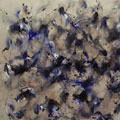
Kiyoshi Hamada has announced an extremely high-quality work one after another in the contemporary art.
He is known well as a high quality painter, from his works being put in a lot of museums as the public collection. He has a lot of influences on the art field by it and has been supported deep-rooted by a part of art fans and collectors.
But also it is true that there is few chances to touch personally with his works except a part of art fans and collectors. It is different from other artists who catch the wave of the boom.
This time, -DOKA Contemporary Atrs- collected and introduce the works of 80's, by the concept of "Shift to the expression by the line and development afterwards", to look back on tracks of Kiyoshi Hamada with him.
For Kiyoshi Hamada, who is continuing to grope for the point of contact of his own world and the society, the painting is the only one way to explain his sense which cannot be explain by words.
Please expect that the transparent feeling that Kiyoshi Hamada draws harmonizes with "Air" of the place and it is going to give the former fans the new fresh feeling in this exhibition. |
 |
|
|
May 15 - 27, 2006 |
Redonnée & Jun Ogata |
|
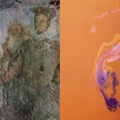
The painting exhibition by Japanese and French artists of same period.
They have relations and the origin with "Classics" respectively while expressing quite different modern expressions in the work.
The French artist Redonnée expresses a peculiar material feeling and the expression of historical portraits and events by mixed-media technique like collage or overpaint.
Jun Ogata shows his original atmosphere with watercolors, which was replaced from effect of coloring by "Classic technique" of western style painting, as the undercoat and the tone of a color. |
 |
|
 |
Copyright © DOKA Contemporary Arts All Rights Reserved. |
|
|